Exploring the theme of world building, with a focus on the theater of the mind, I asked my friend Neil to sit down with his insights. As mentioned in the interview, he has extensive TTRPG experience and has been playing TTRPGs even longer than I have. He has some experience running things as well. Given his volume of experience, as well as his mechanical focuses when designing how different characters work, he seemed the ideal sort of person to speak to about immersion and world building from a player perspective.
The original recording of the interview was done on Zencastr.com and the transcripts were originally created by Riverside.com, then edited by myself for clarity. The original, unedited audio can be listened to below. It is about 25 minutes long. The outline of the questions was put together using ChatGPT, then edited for different terminology and flow.
Andrew: Well, thank you very much for joining me on this endeavor. To start things off, when you sit down and you play a tabletop RPG, how much of the world that you're experiencing feels like it's been created in advance? And how much of it do you feel you're exploring as you go?
Neil: Honestly, I'd say it's like a 40/60, or 50/50. It feels like a lot of the landmarks are created in advance the same way that you can see stuff on the horizon when you're driving or traveling, but anything in between doesn't so much feel created advanced except like on obvious like travel paths and stuff like that.
Andrew: What do you mean by travel paths?
Neil: Like main roads and stuff like things you'd see on like a large overarching map. Like those feel like they're already created, but say the party just decides to cut through a forest to decrease travel time. That feels like it's completely off the cuff.
Andrew: I see. So the big obvious monuments and big set pieces like a castle or some sort of obvious mountain or, you know, a natural landmark out in nature that feels like it would be more crafted versus you're out in the wilderness.
Neil: Yeah, or like a better example would be you can see the ruins of like an ancient civilization in the jungle. The ruins are all planned out, but the actual path through the jungle there feels completely off the cuff usually. Because I mean, how do you plan out a route through the jungle unless it's already been placed?
Andrew: Right. So do you think there's a happy medium between what's prepared in advance and what's off the cuff?
Neil: I think there really much is and as I stayed before it the happy medium that I think exists is having the landmarks and everything placed down and road infrastructure, that makes sense. They like civics and economics and such like like general travel paths as there would be in any civilization. But then having little dots like a maybe a hamlet of small fishing hamlet that has like a population of 20 and other places like that, those I feel like are need and can be generated off the cuff because there's nothing that says they're not there, but there's nothing that says they're there either. So why plan for it if it might never be a thing when you could just generate it when you need it? Your players may never even go that direction, but if they do you just have them go that you like you generate what you need.
Andrew: So we've been part of groups together for a long time now. And I know that you've created a lot of background elements and characters, all that sort of stuff for different groups, including the one that we're both players in at the moment. Are there any of those you can point to that have felt like you have a particular set of sense of ownership when you encounter that element in the game?
Neil: In particular? I can't remember the character names because I always name things based on concepts in my head, but there was Color Gnome with a shotgun, and Druid Artificer or Druid Robot, those two. Which is Bug. That one we I can remember the name on, but his other partner, the one with the chromatic shotgun, I'm very proud of. It's a very backwards character, but it's very amusing. And I was able to do a lot of things that I feel I couldn't have done as a player character.
Andrew: Which to be clear are both non-player characters. The current campaign that, actually, I should say probably the last campaign, given that that literally ended a few weeks ago.
Neil: Yes, both are NPCs. I was I was able to get a lot more freedom with designing them than I would have if they were player characters. I was given concepts to run with and then I got to mechanically make those concepts work.
Andrew: So we've touched on that a little bit already, but do you feel like you've ever added something as a player in terms of a location, an idea? We mentioned the character already which gained a certain level of bigger importance that's more than something of a monster of the week, something that keeps coming back.
Neil: So this one's in a campaign that you weren't part of, but Matt was, and Matt was DM for it. And this is a campaign for people who are less experienced with D&D and also less experienced at not just abusing systems in place, like flight, for example, just abusing flight.
Matt is another member of our Dungeons & Dragons group who also regularly runs his own games, occasionally for us as well.
I remember making a joke about chickadees that attack anything that go over a certain height in this enchanted forest we were in. And offhandedly mentioned my character threw a rock up 30 feet. As soon as the rock hit 30 feet, the rock was gone and there was a flash of feathers. These things remained a steadfast part of the campaign for the entire duration to keep any flight shenanigans in check when the DM needed them in check. The chickadees were terrifying, like flying piranhas. And they weren't so much of a stat block as a rule set in place to make things run smoother for a group that wasn't as good at knowing when's the right, like when to not do certain things like flying 300-400 feet in the air during a combat because you're a Ranger.
Andrew: But that's a really awesome example because it's flavored in such a way that you don't have to necessarily think of it as a constraint placed upon you as a player. It's something more organic that, I mean, you could tangle with it, but why would you ever want to chance that as?
Neil: We did take a with it when we had to climb up ⁓ a cliff in that same forest. That's where he found out how much damage they do Spoilers, it's a lot
Andrew: I can imagine it was a lot, especially given the context and probably being fairly well into the course of the campaign.
Neil: Yes, like i think we are level seven or eight. So they hit hard and as I said, they were more of a force of nature as well. So that's why I like them sticking around like they did and they keep getting referenced at that table. Anytime, anytime someone's thinking about flying 30 feet, someone throws a rock above 30 feet to check, even though we've moved on from that campaign.
Andrew: So that's a good example of the next question partly. As a player, when the world reacts to your character, what kinds of reactions do you think are most meaningful?
Neil: The most meaningful reactions? Punishments. And I think that characters being punished for their flaws makes some of the most meaningful and interesting reactions when it or when a character does something because that's what their character would do and it's not necessarily a good thing. Think any good character saving the orphan kid, for example, is something that you'd come to expect. But, the rogue, say, saving them and then being like “and I didn't even get a reward” can because the character is greedy will stick in your mind more and that type of character's comment and the way that character interacts usually leads to more, for lack of better term, shenanigans.
Andrew: So to clarify by punishments, you mean a character doing something detrimental to themself.
Neil: Or others, or in any way.
Andrew: In spite of the consequences.
Neil: In spite of the consequences. Or something just like a detrimental character trait, a negative thing, being greedy to the point of excess. The punishment there is that everyone's going to look at you as greedy to the point of excess. But the way that that changes how the other characters interact with you then afterwards as well and how NPCs and how the DM will interact with your character is the punishment, so to speak. A good example would be Rock Broccoli and my dibs rule that I've been using. Even though I've hoisted all the punishment onto the fellow players for that one.
Rock Broccoli is Neil's current character, in reference to a game we are currently both players in.
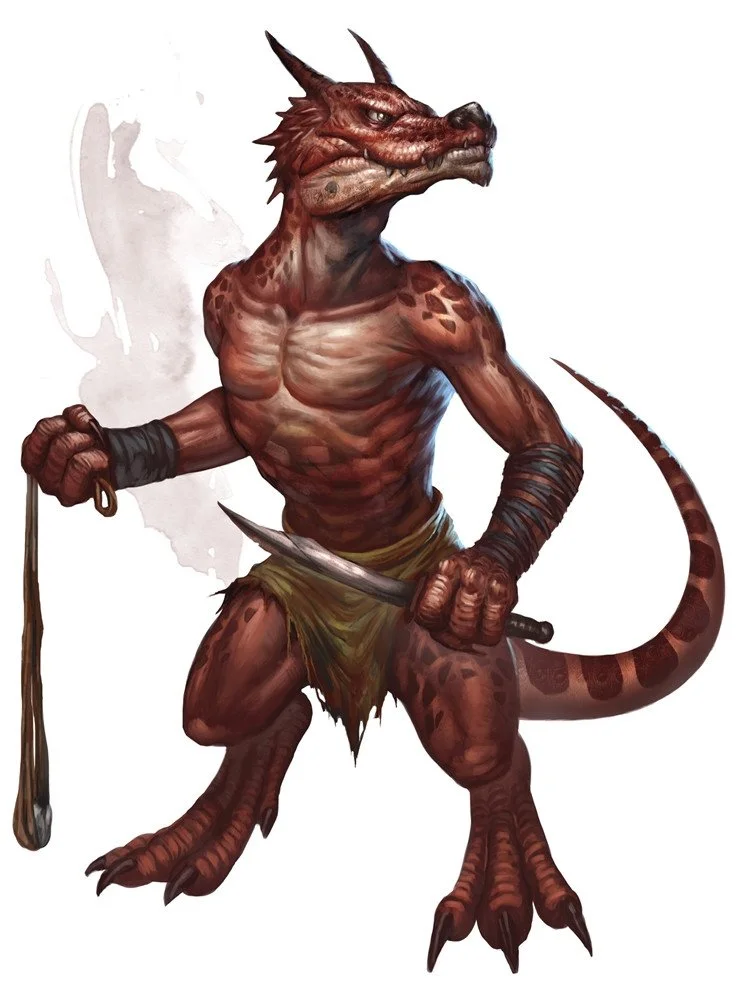
A kobold, pictured from the 2014 Monster Manual from Wizards of the Coast.
Andrew: Yes, yes, you really have in our current game. My god. There have been some rather, I guess, extraordinary consequences in some cases.
Neil: In some cases, yes, but as a result, all the players are taking magic items much more seriously and are even considering just keeping around random scrolls to try and barter with me. It's completely changed the dynamic of loot by the one character alone. And it's a completely negative character trait, but it's completely changed the way everyone's working with loot and not in a debilitating way. Because you can con me out of something worth more value.
Andrew: So I want to come back to the idea of punishments quickly. Is there another way that you can think of with punishments being effective beyond just someone doing something in spite of the potential negative outcomes related to it? Is that something that needs to be... I guess thought about more in terms of less of a role playing angle and more of ⁓ a rules side of thing.
Neil: At times yes, I think as a rule side thing, instead of just being there, but I feel the punishments help to drive the story forward more is the main reason I find them memorable.
Andrew: And do you think that that's something that is important for the players to take on themselves, thinking about how their character is interacting within the narrative?
Neil: Yes, I believe it is important for the players to keep it in mind themselves. And I think that considering those negative traits are and sometimes even exaggerating them as we do in role play are what allow good storytelling to come about.
Andrew: Right, because not everyone is playing a perfect character, so to speak. They're playing something real with flaws and things they're good at, things they're terrible at.
Neil: There's a saying that I heard once that best describes it. No one who has a stable income and a family and a house is an adventurer.
Andrew: That's a very reasonable point. Yeah, why leave the comforts of your own home if you don't absolutely have to or unless you have a screw loose?
Neil: Exactly. So sometimes playing into screw loose is even though you may as a player know that this is going to bite you in the butt, it's the best way to move the story forward. And by far the most interesting and it gives other players opportunities to step in as well.
Andrew: Absolutely. You touched on it briefly a few minutes ago in terms of rules fitting specific contexts and the limitations of them. And I think you've experienced this a little bit more explicitly with some of the more recent rule changes we've had within our own group. How do you feel when rules don't quite cover what it is you'd like to do in a given moment or in a given scenario?
Neil: Apprehensive because most of the time when rules don't cover what I want to do, and this is I think mainly just due to the nature of how much of the core and rules and regulations to the game I have just memorized at this point due to use. Because I know most of time I'm still tangentially within one or two degrees of freedom of the rules, so to speak, compared to being completely within unrealistic territory. So a lot of the time when the rules don't cover something that I want to do, it's a discussion point and I'm usually apprehensive because it's going to be a 50/50 pretty much. It's “I have to sell that this works with a certain subset of the rules”.
Andrew: Is there any kind of specific example that you can give in that regard?
Neil: The best example recently I can think of is the spelljamming helm description because it is so poorly written. I had to work like closely with Ralph to be able to use it and also make sure that we didn't just all of a sudden acquire a spaceship instantly.
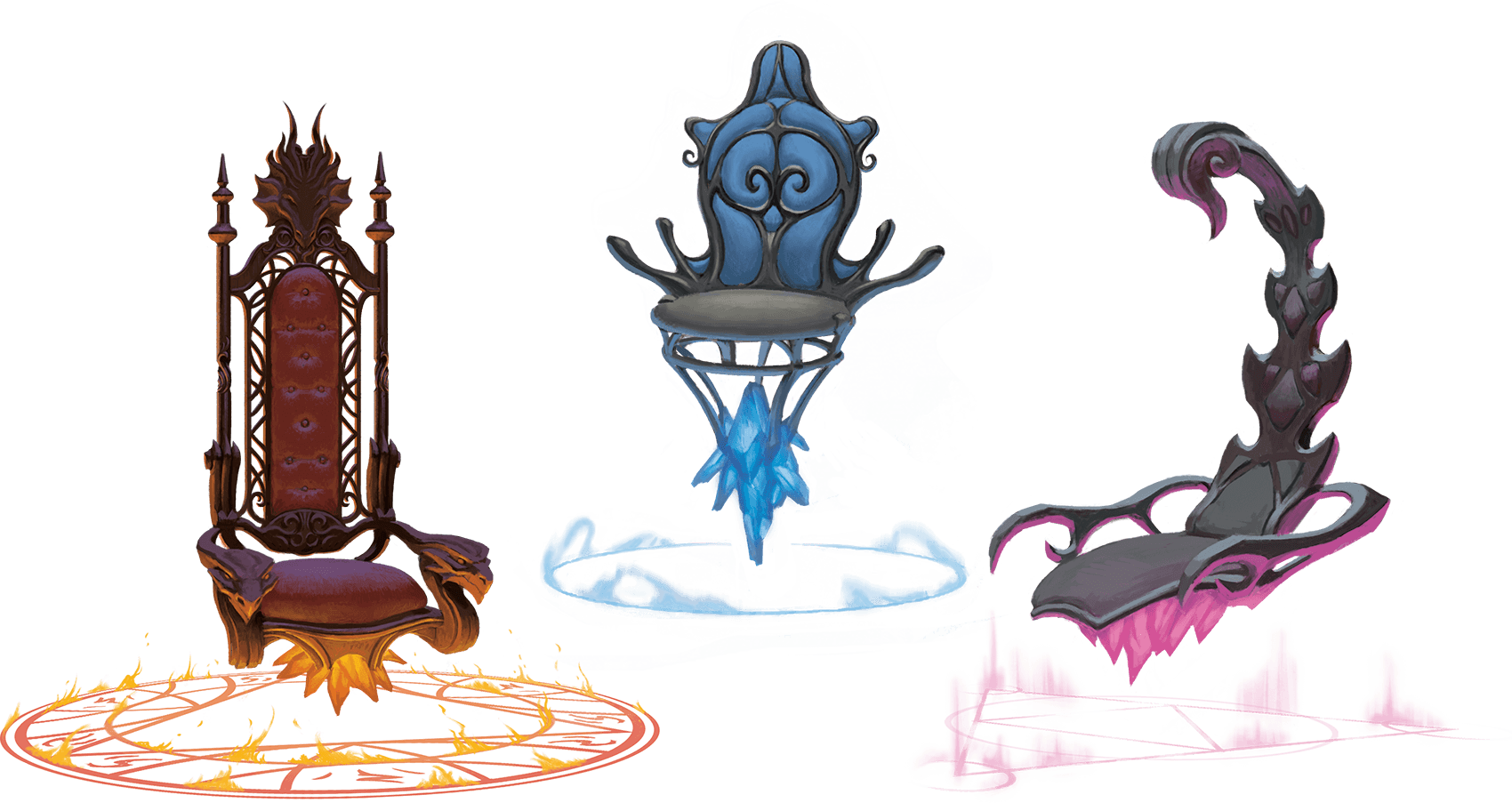
Spelljamming helms, from the Spelljammer: Adventures in Space book from Wizards of the Coast.
Andrew: Right, right, because I remember with how it was all framed, there were very few limitations with how it all...
Neil: Exactly. No limitation referencing atmospheric integrity of the vessel, which I discussed with Ralph to add so that we just didn't have to deal with the spaceship nonsense. Because the party wanted a flying ship from like the moment we saw a flying ship in our setting.
Andrew: Right, and to some extent that's a challenge to do with certain things designed from different modules that are not necessarily compatible together. So finding that sweet spot to mix them is difficult.
Neil: Exactly. And that's why I said like, I'm apprehensive because it's not the sort of thing where I'm saying, Hey, can I have a golden gun that kills everything in one shot to the DM, which obviously, that's going to be a no, I'm saying, Hey, this thing is reasonable. But this is why it doesn't work out what you're ruling on this as the final say. So that's why I'm usually apprehensive about it.
Andrew: It being a collaborative endeavor rather than looking for an absolute ruling on how we're going to proceed. So along those lines, what do you think makes the game feel more flexible or rigid from the player's side of things?
Neil: The ability to inject creativity into things despite them being structured. The best example I can give to this is how Ralph managed to make an all-human setting actually interesting. One of the biggest things is he allowed you to potentially cherry pick certain features as a feat or a trait from other races, if you could explain why your character would have that. everyone was still human, but you weren't pigeonholed into all having to be the same human, if you know what I mean.
Andrew: You had a lot of leeway in terms of what you could get away with based on how you were able to incorporate that into who your character was or what they wanted to be.
Neil: So in that case, it's it's something that's rigid. But because of the flexibility he allowed as a player, it didn't bother me at all. It didn't feel like I was in a box. Even though I was very obviously in one, the choices were human or human.
Andrew: But the collaboration there made it such that you were still able to have fun without feeling restricted.
Neil: Yes. You are still able to take a concept and make it work.
Andrew: So looking back, and you've been part of a lot of campaigns over the years. You're probably one of the few people I know that I actually can't fathom just how much you've played in the way of TT RPGs over the years. What parts of a campaign tend to be the most memorable for you? Are they significant for plot reasons? Is it role playing? What do you tend to keep coming back to in your mind?
Neil: The all or nothing gambles and catastrophic mistakes. Those are the two that I will never forget
because the all or nothing gambles are either a catastrophic mistake if they fail or they're a very good story if they succeed and the catastrophic mistakes always lead to something funny.
Andrew: Funny or interesting. I can definitely agree with that.
Neil: Exactly. Funny or interesting, they're never boring.
Andrew: Yeah, there's always something wacky that comes out of it and nobody ever quite knows how it's gonna go.
Neil: A good example would be your character's use of your magically infused staff to grow an entire coral forest. That's what I'd remember as an all or nothing gamble because you have no idea how well it's going to work. I believe you ended up rolling percentile die to determine how well it worked.
Andrew: Yeah, there were a lot of question marks in there that I just kind of moved on from and figured, well, I don't know what's happening, but clearly the person who's running it did.
Neil: But this is what made it memorable was the fact that it's not like an attack role where you either hit or miss. You did your thing and you had to wait to find out we all did. And then it was spectacular. But it would have been just as funny if like a single piece of coral popped up in front of one ship. We would have all died laughing.
Andrew: That's very true. I mean, I personally felt like there were pretty good odds there of things going the bigger way of what they could have been. But you're absolutely right that looking back at it, had I rolled really low, it might've been extraordinarily middling.
Neil: And that's what makes the that's why I say so all or nothing gambles I guess is the wrong term. It's more the gambles when the with odds are the fun part when it's stuff that you know is not just hit or miss. Those are what I remember the big moments like that.
Andrew: Big moments where it all comes together or it all comes crashing down. Good way of putting it.
Neil: Exactly. Yeah, that's a very good way of putting it. Because they're always amusing. And sometimes when it all comes crashing down, it all comes together immediately afterwards, because someone pulls a Deus ex machina.
Andrew: I have to admit, I can't think of a time where that happened for me personally, or for someone in our group, but I guess that's also part of the wonders of the game. So my last question for you, from a purely player perspective, what do you think contributes most to the game world feeling real or lived in?
Neil: From a purely players perspective, it's me being able to comprehend of an idea or a thought that is reasonable and includes mainly common knowledge and such out of character, realizing and working out logically that my character reasonably could have the same idea such as researching information in a library. Mike, if I look at my care sheets, like, okay, I am not dumb as a brick. My character could reasonably think of this. And then going “is there a library in this city center and finding out there is and spend and then going through that whole entire side plot line basically to research whatever it was I wanted to research being able to take like a common idea such as that.
It exists in the game world. And I knew that it like the chances that the DM had planned out this library beforehand were probably nil. But being able to know that stuff like that can be there or like looking for say you're trying to make a potion you need very specific supplies looking for a specialty store. Stuff like that is things that we do nowadays is common knowledge you need something for home like tools and such you go to home hardware.
Like we have specific stores and such we go to, have specific places and goals and being able to think of that as out of character as a person, then apply that knowledge to my character within reason and have it be available is what makes the world feel alive and normalized, I guess is a better way to put it.
Andrew: So it's partly that familiar problem solving methodology or lack thereof in the case of, well, I can't reasonably make that distinction. What else can I do?
Neil: Exactly, yeah, those moments because that's difference between you as a person and the player character. The knowledge base is completely different and most times should be extremely limited compared to you as a player's knowledge.
Andrew: Interesting. You actually went a completely different direction with this than I thought you would. I thought for sure you would lean more into the role-playing interactions. But that's a very interesting take on that.
Neil: Because the thing is that the world can't exist without little points of interest, so to speak. And if I'm just going between point A and point B constantly and there's no little points of interest, it's not as interesting to the world's just not as alive.
Andrew: Right, right. It feels like you're interacting in very limited formats.
Neil: Yeah, like if we're in the upper noble area of this large city, I would expect to be able to find a clothes store that caters to nobles. And I want my fancy underwear and I want my fancy suit.
Sources
OpenAI. ChatGPT. “Put together a series of interview questions focused on player agency and game rules with a phenomenological spin on them..” 22 October, 2025.
