For the next interview, I sat down with my friend Ralph who just wrapped up a campaign that he had been running for our Dungeons & Dragons (D&D) group for the last three years. Ralph is the first person I’ve met to use a personal wiki to keep track of all the different NPCs, places, and plot points that is over 800 pages strong as he prepares for the third campaign in his own homebrewed world. Due to some time constraints we had, this might read more like a discussion, though multiple of the questions I shared in advance were answered in his long form answers. The game master, in the context of D&D, is called a dungeon master (DM).
The original recording of the interview was done on Zencastr.com and the transcripts were originally created by Riverside.com, then edited by myself for clarity. A small portion of ambling was cut from the end of the transcript which can be heard in the original audio, which can be listened to below and lasted just over 30 minutes. The outline of the questions was put together using ChatGPT, then edited for different terminology and flow based on the original questions from the prior interview in order to try to examine the same ideas from across the table.
Andrew: Ralph, thank you for joining me.
Ralph: No worries, thank you for having me.
Andrew: So you've been DMing for many years. And you're one of the people that I'm actually most impressed by the amount of prep that goes into running the game. It's pretty staggering, actually. So when you're preparing your settings, how do you decide what needs to be fully defined and what do you decide can be left open for the players to fill in?
Ralph: So this one is actually pretty tricky and very fluid, I would say, because over the years I've been DMing, it's changed, right? At first, I would prep everything. I would prep every single thing in the setting at a high level and at a low level that I thought the players might do.
And obviously that's just as the years have gone on and I've gotten better, I've realized that this is just impossible. Like you can't do that without burning out. It's way too much of a workload. So I think what my philosophy, I guess, is now would be...
The world is... Basically a facade in a way and it just has it has to be just believable enough that players Believe that I have every single answer when obviously I don't because nobody can so What that means in terms of prepping like a new world right now or a new setting or a new campaign? Means at the highest levels. Yeah, sure you need some basic things, need to have some ideas about religion, countries, and basic politics, names for places, and probably some important people. And that's where I start. I start very high level like that. And then I start thinking about the exact opposite. Okay, where is this going to start? Who are my player characters going to be? And then I start building around that. Okay, I have these five or six characters. This is what they've told me about who they want to be. So how do I build a campaign or a world or setting that will fully integrate those characters to achieve their goals?

So obviously when drilling deeper into a very specific area of a world that players are actively interacting with, session to session, the things we're actually talking about when we're playing at a given time, all of that to me needs to be very well defined. If someone asks me where a shop is, I need to be able to answer that question. If someone asks me, well, what might my character know about this? Because you know, I'm from this area, I know these types of people. Those questions have to be answerable. And that's how I prepped this campaign to start. So I zoomed out a lot. I'm currently in the process of preparing a campaign and it's in a world I've already built mostly, but obviously I've left a lot of gaps in that world. The first campaign I ran in the world was in a specific country and I knew the important details of all of the other countries, but it wasn't important to develop things like cities or anything like that.
The second campaign I ran was also in, essentially, another country. But now the third one is going to be across the entire world. So all of these places that I've neglected do have to be filled in. And I think it's really important that the way you're filling it in makes the world feel alive and varied. A very common bit of advice I think that is given, especially for new DMs, is if you're going to have something like cities, let's say, maybe one or two is fine because it's really kind of difficult to make seven or eight different cities, characters are going to forget what's in what city, they're not going to feel as varied. And so that was a big pain point I've had recently about, well, I have all of these cities, they all exist. The players know they all exist. They all have to be varied, interesting, and have reasons to be there. In terms of leaving things open for players to fit in, I actually have a really good example of this in the current campaign I'm preparing. So I have this country where it's kind of magical might makes right, and I've always thought about it from the lens of, the people who believe that and the people who are very strong magically, and the people who aren't, who are maybe commoners or even potentially slaves, things of that nature.
I have a character in the campaign who's from a noble house in this country, but he's not magical. And that kind of totally shook up everything I was thinking about because, okay, this is a totally different perspective that I just didn't consider in my preparation. What would the country politics and philosophy and just day to day life of this character be? Who is in this place, he's practically from a noble house, he's very important. But he himself doesn't have what they consider important. And that's just a perspective that I didn't feel like I defined. So I had to go back and basically re-examine everything I'd built about this country and say, okay, but there's gonna be people like this. Where do they fit in? And so that was actually really fun to think about and prepare for.
Andrew: So do you think the big thing that you get out of interaction with your players is figuring out what those different perspectives are and trying to fill in around them? Or is it partly shaped by that and largely relying on prior set pieces that you've put together in advance?
Ralph: I think you said building around them. So for example, building around this perspective, I actually think it's building for that perspective a little bit more. I don't want it to be in this example. It brought up, you know, this part of my of my world of this country that actually is super important and probably causes a lot of interesting conflict and dynamic in this country.
These people are not commoners. These people are relatively important people in the country. Their perspective therefore matters. And so it kind of becomes or should become central. It's very important to the character and thus I think it has to be very important to the world because that's what's satisfying for players.
Andrew: Right, of course. And I mean, if the characters aren't being interacted with, then what's the point?
Ralph: Exactly. And that's at a high level though, like that's preparing at the beginning of a setting. But I think that this also happens obviously as you play through a campaign, as you kind of zoom in, like I said earlier, session by session, a player might think of something about their character or might have an idea and that helps you fill in that world. And I think you have to be adaptable for that. I think that's really really important otherwise you're not playing you know D&D or a TTRPG or whatever. If you're unable to do that I think that's a big problem. You can't be so rigid in your preparation that you're telling your story and I think that's where a lot of people kind of fail. It has to be a collective effort.
Andrew: I could not agree more. And to that extent, I think what kind of set your games apart from a lot of the other ones that I've participated in is a lot of modules are... The weakness in them is specifically that there is that set story. It doesn't allow for all the kinds of organic interactions and new directions to take as much hold in the players because you're all moving towards at least a semi-obvious endpoint. You you look at something iconic like Curse of Strahd, well, Strahd's a vampire. At some point, we're going to have to deal with that vampire. But it's something that I think is a little bit more common for people that put in the effort like you do, where you have more tools at your disposal to take things in a slightly different direction than a lot of people would expect.
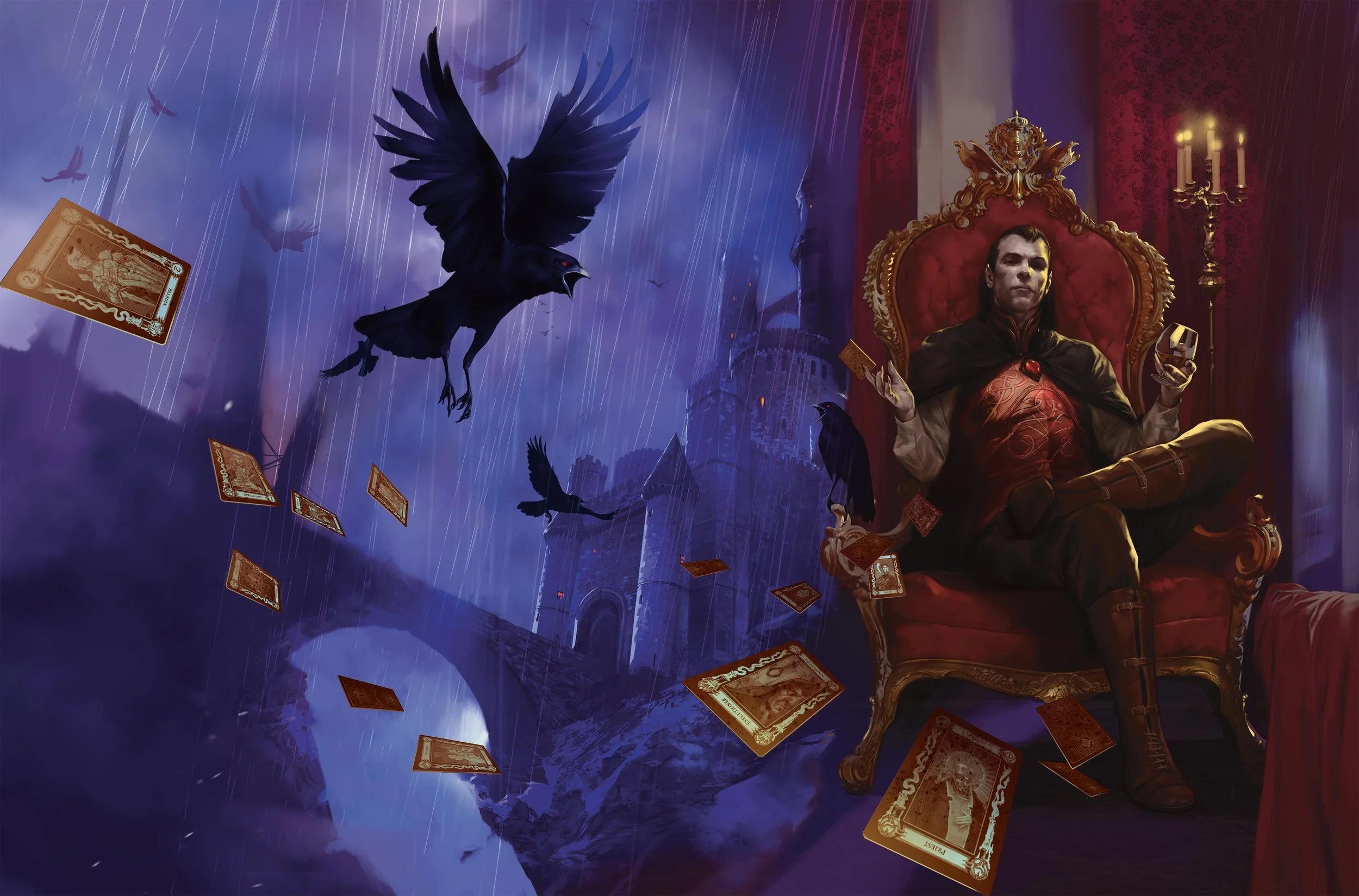
Cover art from the Curse of Strahd adventure book/module for Dungeons & Dragons created by Wizards of the Coast. Image was taken from D&D Beyond.
Ralph: I also think it's easier. You brought up Curse of Strahd. I've tried to run it two or three times. And it's difficult. It's really hard to run these modules. People will complain and say, it's because of how they're written. But I don't think that's what it is at all. I think it's just, you could understand it back to front, you could have it memorized, but if you're not able to adapt in the right way, your characters are going to do something that's not in the book. That's just the game. They're going to do something that's not in the book every single session probably. The very first thing that happened to me when I was running Curse of Strahd, basically you're, you know, it depends how you want to start it, but essentially, you know, whatever happens, you're engulfed by mists and you start up in Barovia and there's mists all around you. And the players go, well, what if I just keep walking in the mist? What happens?
It's actually kind of a difficult question. What do you say to that? you just end up where you were. That's kind of what I did because I was new and I did just, you know, the book says you got to go to this haunted mansion. So that's where you're going to get there one way or the other.
Andrew: In fairness, I do think that the book does literally say to railroad in that regard with the mist automatically points you in the direction that you need to go, no matter how you wander through it. I'm not saying it feels good. I mean, it gets you to the next point in its set points along the adventure, but it doesn't necessarily feel as good.
Ralph: It feels terrible and quite frankly it made me feel a little bit dumb actually I would say. You can do so many different things when something like that happens. You can, you know, let's party says “well screw this we don't like this what happens if I walk into the mist?” Well maybe that's okay. Maybe you just move where the haunted mansion is. You just reorient where, uh, I forget what this... I think the town is also called Barovia, actually, if I'm remembering right. And you just, you know, maybe they end up on some farmland. They meet a farmer who tells them about the mansion or a passing caravan of the... I forget what the Romani are called in Curse of Strahd as well now. But anyway, the point being there's so many different ways you can handle that situation so easily.
But it's just the first question I was posed as a DM and I was like, well, I don't know. You end up back where you started. And the point I was trying to make, I suppose, is I don't think it teaches you how to answer that question. You have to answer that question 50 times every session. And you have to be able to keep doing it every single time. And so it's common advice to say, run a module. It's easier than building your own.
It's not. It's really not, because you will have all the answers when you build your own world. And you can make up the answers and not be worried that you're breaking something 70 pages later. And I think that's important.

Andrew: So I'm going to come back to that in a moment. But you touched on the point of the mist as a sort of game mechanic. How has adjusting mechanics gone for you in terms of building atmosphere or pacing in the world? So in your last campaign, it took place in an archipelago that we played in. And one of the big items as part of that was sailing ships around and mechanics specifically related to that. But what kind of other sorts of things have you tried and either adapted or had to reconsider?
Ralph: So what you brought up is the first one I'll touch on, sailing. Before I ran that second campaign in the world, we ran three one shots in different parts of the world and I asked the players, hey, which area is most interesting to you? And we took those sailing mechanics and sailing combat mechanics for a spin at that time. And the feedback was basically, we want to go to the archipelago. The ship combat might be an issue. We'll see. We're willing to try it, but we'll see. We maybe use those mechanics three times in a hundred sessions, would think that's an accurate guess, maybe four.
Andrew: I think it was, yeah, it was four or five times. It ended up not being as central as we thought it might be.
Ralph: And that's specifically because every time it came up, it kind of just bogged the session down. So I tried to leave it for, okay, maybe there will be super important times where we use this, but I'm gonna try to steer clear of it more often than not because it's not engaging with the table very well, is what I decided ultimately. So, you know, it could happen. There were still some ship combat random encounters that you guys did not roll, thankfully, throughout that campaign, but yeah, ultimately it was just, this doesn't feel like it's working properly. A mechanic I'm thinking about right now, also introduced last campaign was just some changes to the resting rules, making it a little bit more difficult to get your character fully healed again. Overall, I think those are a good counter example. Those seem to work. I think they basically achieved what I was hoping they would achieve, which was just making
a little bit more sense the kind of distribution of encounters in a session or in multiple sessions. The problem in regular DND or a problem that I think at least I face in regular DND is it's very difficult to fit in enough encounters in a single day that the characters are actually challenged and if you lower the number and just up the difficulty a lot, it kind of becomes very difficult to balance them out. So that one I think was mostly successful, although may still see some changes.
And beyond that, I think in terms of creating mechanics, I think the most important thing is like we have a whole list of house rules that are probably pretty wacky. I would say some of them for many tables, I think they work well in general. They definitely change how you play the game a little bit, I would say. It's important to have a reason for making a new mechanic or adjusting one like you don't do it purposelessly, right? You have to have a reason for it. And I think it's good every, you know, once in a while to look back at that and say, is this solving the problem I had? Yes or no. Cause at the end of the day, you can just get rid of it whenever you want.
Andrew: Right. It's just there for the sake of itself.
Ralph: Exactly. So what I do instead, and I suppose you could kind of say this is another mechanic I've changed, although I wouldn't say I've changed it. I think random encounters are really, really, really important to a game. I think A, it's because it adds to the game in the sense of it's a game. You roll the dice, you see what happens. I think that's critical, like it's so important. But B, they really have to be thought out in a way that makes complete sense. I've, back to prep a little bit, I prepare this area, its magical might makes right, different people think different things about that, and let's say you're in the capital city of this country. Your random encounters are gonna look very, different, obviously, from the opposing country, let's say, where they really don't like magic. And you have to make them in such a way that they add another hook.
They're not purposeless. They don't have to be paragraphs upon paragraphs of preparation. It could be two lines, something like a student at one of the lower academies being bullied by a student at one of the higher academies for not being as powerful of a mage as the other. And that just hammers home that might makes right kind of mindset that permeates the country, that permeates the capital city. And I think that's important because that's how you show it. Like you can tell the characters, you can tell the players, that's what this country thinks. But it doesn't matter if nothing ever comes of that. So and to me, random encounters is where that stuff shines. You can you know, the players, you know, they get a couple pages of whatever they know, they know some things about your world and you show them that using random encounters.
Andrew: Interesting. I hadn't actually thought of them in quite that way. So I'd like to end off on perhaps a bit of a more fun note. When you look back at the campaigns that you've run, what kinds of details have you found tend to stick with your players the most? Maybe it's something small, maybe it's something unexpected. What kind of stands out to you?
Ralph: This one is really tricky to answer because A, it's different for everybody, right? I think... It's first of all, it's never the things I expect. It's never the things I expect.
Andrew: That seems to be the bog standard rule. It's never what you think is gonna really drag people in.
Ralph: In my first campaign, we had a cleric that rolled successful divine interventions, I think three times and all three were incredibly critical moments. It was absolutely insane. Of course, something like that's going to be remembered. You you roll a hundred sided die, you get like a, I think it was like a, over the course, it was like a 10 to 15 % chance of success each time and he succeeded every time. So you remember that. That's a lot of fun. I think oftentimes too, it'll be characters that... Some of them off the cuff, some of them not. Last campaign, there were a few characters like this I would say that were remembered decently. There was a...I even described dread thing he was a kobold
Andrew: Yeah, yeah, kind of like a Witcher-like character.
Ralph: Yeah, he was like a Witcher Kobold kind of. And that was a prepped character, but that was also not like a... I didn't spend an hour thinking about Dreadfang when I prepared him. I thought, okay, there's Kobolds, this guy's gonna be the helper guy who might help them, who's got some combat ability. And then it just kind of spun from there. Or even more, I guess traditionally boring characters like Cornelius, I think Cornelius is probably one of the characters interacted with the most last campaign. So characters, I think, are generally really important, really remembered by players oftentimes. Events can be, obviously. Also never really the ones I would expect necessarily.
Andrew: Yeah, that really feels like the central theme of D &D. It's never what you expect. It's always something seemingly off the cuff or something that you didn't necessarily prepare as much that all of a sudden you're delving into.
Ralph: I think it's also in some cases, and this isn't just in campaigns I've run, this is in campaigns I've played in as well, but... Players themselves will just be remembered for the kind of off-the-cuff zany moments that they... despite all DM protest and attempts to avert it still do things like giant beanstalks. It's things like pyramids popping up in the middle of cities. Moments of epic character death, I think are always, I think those ones in general are always remembered pretty fondly. So I would say, I don't think it's usually the DM that is like creating these remembered moments like sure, you might remember some characters or whatnot.
But I think in general, when like I personally look back on campaigns, whether I've run them or not, the things I remember are typically, wow, that player did something really cool or on the flip side, God damn, how did I let that guy get away with that?
Andrew: Yeah, I think there's a lot of that that goes into running things. And I couldn't agree more that it's the players that really set the stage for the moments. As much as the person running the game, you are creating the set pieces for them to run through and run up against.
Ralph: And yeah, run through them they do very often.
Andrew: Quite literally sometimes.
Ralph: It's a lot of fun though.
Sources
OpenAI. ChatGPT. “Put together a series of interview questions focused on player agency and game rules with a phenomenological spin on them..” 22 October, 2025.
